



项目介绍
Are you excited about designing the next generation of energy-efficient AI hardware? Do you want to contribute to cutting-edge research at the intersection of neuromorphic computing, computer architecture, and hardware acceleration?
The University of Groningen is seeking a highly motivated PhD candidate to join the international QuNeCo project, a collaborative research initiative between leading universities in the Netherlands and Japan. As part of an interdisciplinary team, you will develop novel neuromorphic computing architectures inspired by the human brain to enable future heterogeneous computing systems with unprecedented energy efficiency and performance.
What are you going to do?
As a PhD candidate, you will contribute to the design and development of next-generation neuromorphic computing systems through algorithm–hardware co-design and computing-in-memory technologies. Your research will span the complete hardware design flow, from architectural exploration to hardware prototyping and experimental evaluation.
Project website: Home | QuNeCo
Your responsibilities include:
- Designing novel neuromorphic computing architectures based on application requirements and heterogeneous computing use cases.
- Investigating emerging memory technologies, including SRAM, RRAM, MRAM, and FeRAM, for efficient neuromorphic hardware implementations.
- Developing RTL implementations of neuromorphic architectures using hardware description languages and validating their functionality through simulation.
- Evaluating performance, energy efficiency, and scalability using industry-standard electronic design automation (EDA) tools.
- Developing representative AI and neuromorphic applications to demonstrate the proposed architectures.
- Prototyping hardware accelerators on FPGA platforms and integrating them into heterogeneous computing systems.
- Performing comprehensive experimental evaluations and publishing research findings in leading international conferences and journals.
- Collaborating closely with project partners in the Netherlands and Japan and participating in international project meetings, workshops, and research visits.
- Contributing to teaching activities and supervising Bachelor’s and Master’s students where appropriate.
Faculty of Science and EngineeringApply no later than: 31 October 202623:59 Dutch local time€3.204 – €4.051
Who are you?
We are looking for an enthusiastic researcher who enjoys solving challenging problems and working in an international research environment.
You should have:
- A Master’s degree in Computer Engineering, Electrical Engineering, Computer Science, Embedded Systems, or a closely related field.
- A strong background in computer architecture and digital hardware design.
- Experience with hardware description languages such as Verilog, SystemVerilog, or VHDL.
- Familiarity with FPGA development or RTL design methodologies.
- Knowledge of computer architecture, hardware accelerators, AI hardware, or neuromorphic computing.
- Programming experience in Python and/or C/C++.
- Experience with EDA tools (e.g., Cadence, Synopsys, Vivado) is considered an advantage.
- Interest in emerging memory technologies and computing-in-memory architectures is desirable.
- Excellent English communication skills, both written and spoken.
- Strong analytical abilities, creativity, and the motivation to conduct independent research while collaborating within an international team.
What can you expect from us?
- In accordance with the collective labor agreement for Dutch universities, we offer a salary of at least € 3.204 up to a maximum of € 4.051 (promovendus) gross per month for a full-time employment contract.
- 232 vacation hours per year, based on a 38-hour workweek (1.0 FTE). You can also work more or fewer hours in exchange for more or fewer free hours. For example, with a 40-hour workweek, you save 96 extra free hours, and with a 36-hour workweek, you lose 96 hours.
- End-of-year bonus of 8.3% and 8% holiday allowance.
- Extensive opportunities for personal and professional development.
- A full-time position (1.0 FTE). The successful candidate will first be offered a temporary position of one year with the option of renewal for another three years. Prolongation of the contract is contingent on sufficient progress in the first year to indicate that a successful completion of the PhD thesis within the next three years is to be expected. A PhD training programme is part of the agreement, and the successful candidate will be enrolled in the Graduate School of Science and Engineering. Teaching: Employed PhD candidates are expected to spend 10% of their working hours on teaching and/or supervising students.
Where will you be working?
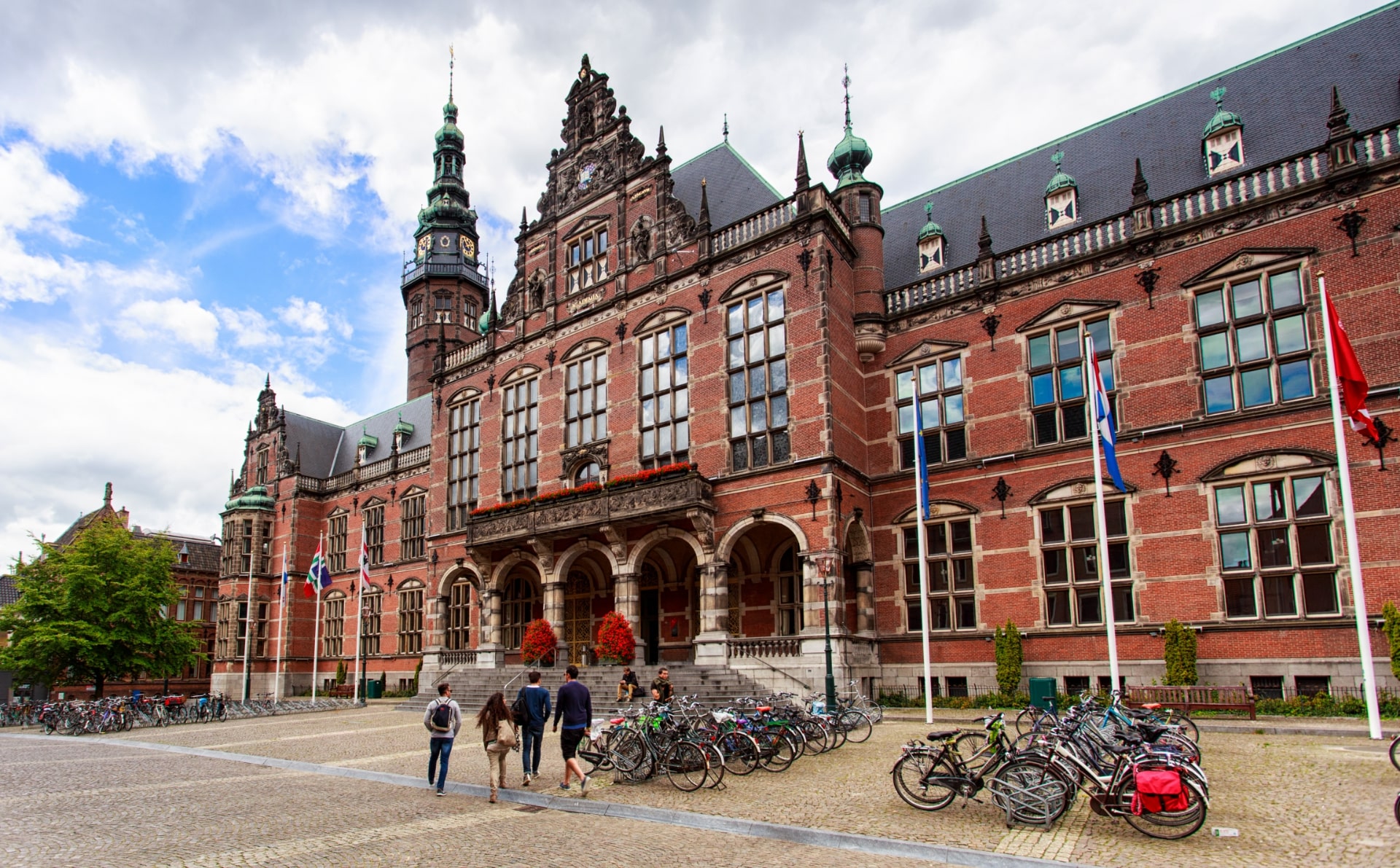
At the University of Groningen (UG), researchers from all fields of academia and technology are working on academic challenges and societal questions. Lecturers prepare their students for meaningful careers within or outside the academic world. Interdisciplinary research and teaching, sharing of knowledge, collaboration with businesses, government institutions, and societal organizations are aspects that are of the utmost importance to this European top university. The UG aims to be an open academic community with an inclusive and safe working climate that invites you to add your value.
The Faculty of Science and Engineering (FSE) provides teaching and research across a wide range of disciplines, from physics and biology to artificial intelligence, mechanical engineering, and pharmacy. In close collaboration with partners from industry, healthcare, and society, we contribute to the urgent challenges of our time, such as energy, sustainability, digitization, and medical technology. Our community is open and informal, with more than 7,000 students, 1,000 PhD students, and 1,400 staff members from all over the world. If you would like to learn more about the Faculty of Science and Engineering, visit rug.nl/fse.
The successful candidate will join the Bernoulli Institute for Mathematics, Computer Science and Artificial Intelligence within the Faculty of Science and Engineering at the University of Groningen.
The research will be carried out in the Innovative Computer Architecture group. The group of Dr. Farhad Merchant conducts internationally recognized research on computing-in-memory architectures, neuromorphic computing, hardware security, and energy-efficient computer systems. The candidate will become part of the QuNeCo project, an ambitious collaboration between universities in the Netherlands and Japan that aims to develop next-generation heterogeneous computing platforms by combining emerging hardware technologies with novel computing paradigms.
The position provides extensive opportunities for international collaboration, research visits, interdisciplinary training, and interaction with leading academic researchers across the consortium.
This PhD position offers the opportunity to collaborate with internationally renowned researchers, publish in leading conferences and journals, and gain experience in architecture design, hardware implementation, FPGA prototyping, and AI applications.

联系方式
电话: +31 50 363 9111相关项目推荐
KD博士实时收录全球顶尖院校的博士项目,总有一个项目等着你!